Bell ringers that tell you something: 15 ideas for the first five minutes
A bell ringer is a short task waiting for students when they walk in — on the board, on a slip or on a screen — that they start without being told. Teachers also call it a do now, a warm-up or, in the UK, a starter. The useful version is not something to keep a room quiet while you take the register. It is three minutes of remembering a past lesson, and it tells you something before you teach the next one.
What a bell ringer is for
A bell ringer does three jobs at once, and the first is the one people notice. It is a routine: students know what to do the moment they arrive, so the start of the lesson does not depend on you being free to start it.
The second is review. The first of Barak Rosenshine’s principles of instruction is to begin a lesson with a short review of previous learning, and he describes an elementary maths experiment in which teachers were trained to spend eight minutes a day on review. A bell ringer is the cheapest place to put that review, because it happens while you are doing everything else.
The third is information. If you read the answers, a bell ringer tells you what survived from last lesson before you build on it. That makes it a small piece of formative assessment at the other end of the lesson from an exit ticket.
A bell ringer that copies the learning objective into a book keeps the room quiet. One that asks about last Tuesday tells you something.
Four rules that make one work
Doug Lemov’s description of the Do Now in Teach Like a Champion is still the clearest set of rules. Paraphrased:
- Same place, every day. On the board, on a slip on the desk, or on the screen. Students should never wonder where to look.
- Done alone, with no directions. If you have to explain how to do it, it is not a bell ringer yet; it is the start of the lesson.
- Short, and written. Three to five minutes, with an answer on paper or on a screen, so you can see who has done it.
- Reviews or previews.It either brings back recent material or gets students ready for today’s.
Lemov’s other warning is the one most often broken: keep the review that follows to about five minutes, and go over the answers students got wrong rather than every answer.
15 bell ringer ideas
Recall a past lesson
- Three questions on last lesson. The default, and the best one. Multiple choice is quick to check; one short answer tells you more.
- One from last week, one from last month. The older question is where you find out what has quietly been forgotten, and asking it is how it stops being forgotten.
- Fix the mistake. A worked example with one wrong step. Students find it and write the correct line.
- Brain dump.“Write everything you remember about the water cycle.” Two minutes, books closed. More on this in twelve retrieval practice activities.
- Label it.Yesterday’s diagram with the labels removed.
Make them think
- Which one does not belong? Four numbers, words, shapes or dates. There is more than one defensible answer, and the reason is the answer.
- Estimate first. How many seconds in a day? How tall is the classroom door? Commit to a number before any calculation.
- Agree or disagree, and why.“Multiplying always makes a number bigger.” One sentence of reasoning.
- Notice and wonder. An image, a graph or a short quote. Write one thing you notice and one thing you wonder.
- Finish the sentence.“The difference between weather and climate is …” Good for vocabulary, and quick to read.
By subject
- English:one sentence with two errors to correct, or a line from the class novel — who said it, and when?
- Maths: one problem, solved two different ways.
- Science:predict what will happen in today’s demonstration, before you see it.
- History and social studies:a short primary source — when was this written, and how do you know?
- Languages: translate three phrases from last week, in both directions.
Bell ringers for middle school and high school
The same ideas work at both ages; what changes is how much structure to give.
In middle school, keep the format the same every day so the routine carries the weight: the same three-box slip, or the same three-question quiz, with only the content changing. Sentence starters help students who freeze at a blank page. Keep it short enough that nearly everyone finishes.
In high school, reach further back. A question from last month is more useful than one from yesterday, and students can cope with the discomfort of not remembering. Past exam questions, “explain why” prompts and fix-the-mistake examples all work. Older students can also check their own answers against a key on the board, which shortens the review.
Bell ringer questions to steal
These work in almost any subject. Fill the gap with last lesson’s content.
- What is the difference between ___ and ___?
- Explain ___ to a student who was absent yesterday.
- What mistake would someone make with ___, and why?
- Give an example of ___ that we did not use in class.
- What question would you ask to check someone understood ___?
- Put these in order, and explain your first choice.
- Which of these does not belong, and why?
- What is the first step in solving ___?
- Draw ___ from memory, then label it.
- True or false: ___. One sentence why.
For bell ringer topics, look at what you taught one lesson ago, one week ago and one month ago. That is the whole list.
A week on one page
A bell ringer template that lasts: one sheet per student per week, five boxes, collected on Friday. It keeps the answers together, so you and the student can see the week, and it means late arrivals know exactly where to start.
| Day | Question | My answer | How sure? (1–4) |
|---|---|---|---|
| Monday | One question on last Friday's lesson | ||
| Tuesday | One from yesterday, one from last month | ||
| Wednesday | Fix the mistake | ||
| Thursday | Which one does not belong, and why? | ||
| Friday | Brain dump: everything about this week's topic |
The confidence column is worth the space. A student who is sure and wrong is telling you something a plain mark would hide.
The first five minutes on a phone
I build TeachRoster, so read this as a description of one way to run a daily bell ringer, not the only one. Paper works, and in a room without devices it is the right answer.
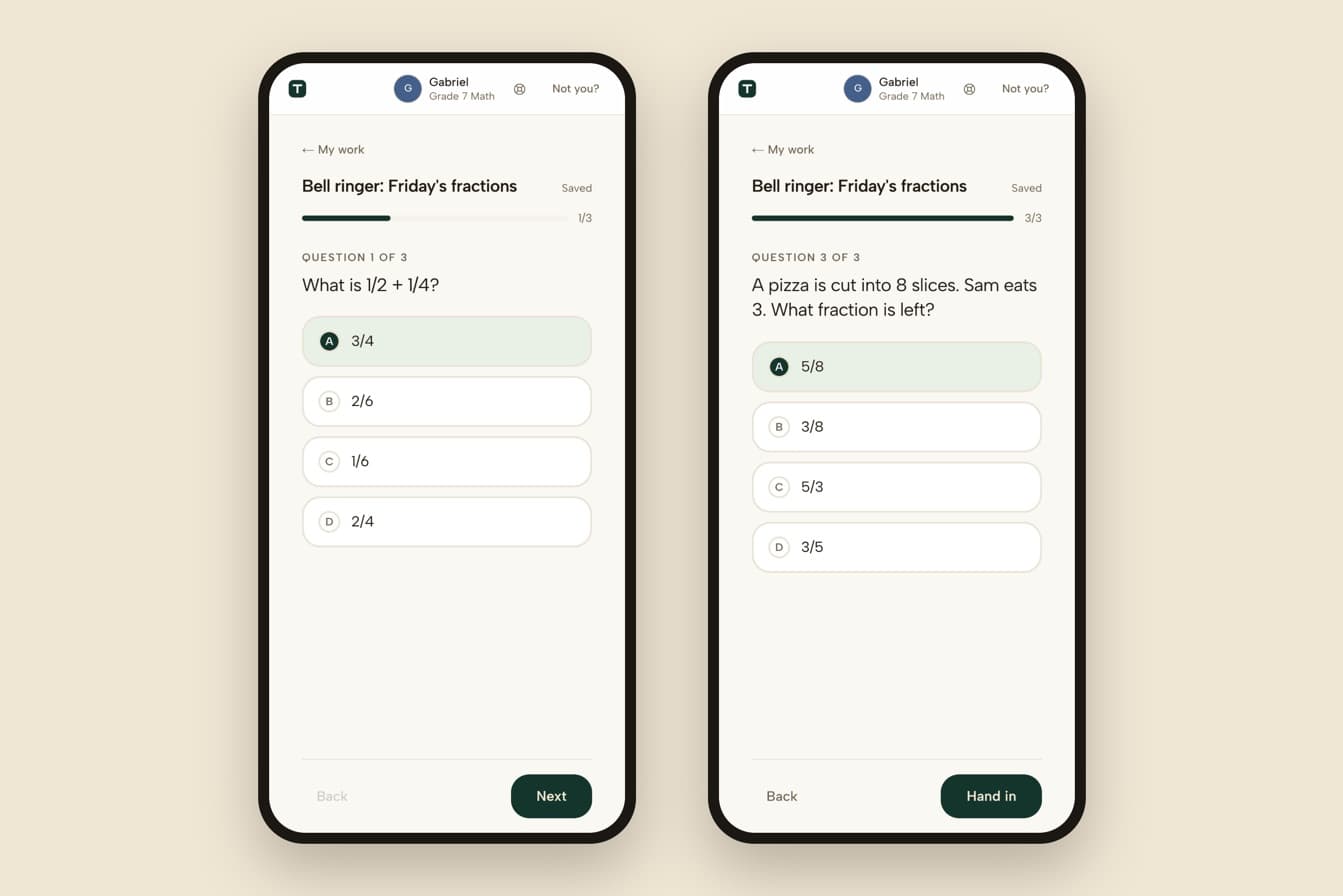
Where students have phones or Chromebooks, a bell ringer can be a three-question quiz on last lesson. You can write the questions, or have a draft made from the notes or PDF you taught from and edit it. Multiple choice and true/false mark themselves, so a bell ringer made of them needs nothing from you once it is set.
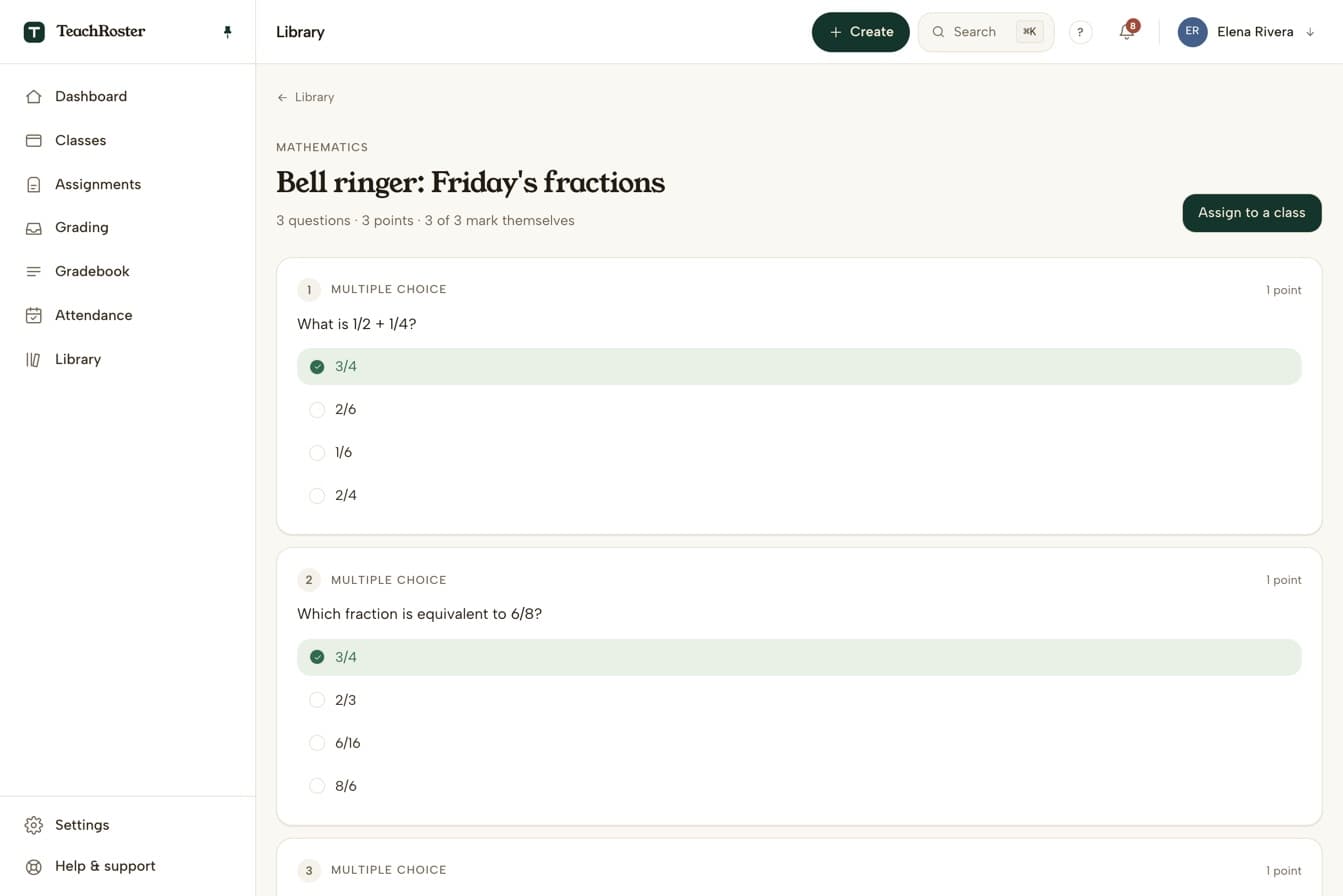
Set it as Practice and it never touches the gradebook. Students open it from their list of work as they sit down — no email address and no account, just the class code and a four-digit PIN they chose once — and their answers save as they go.
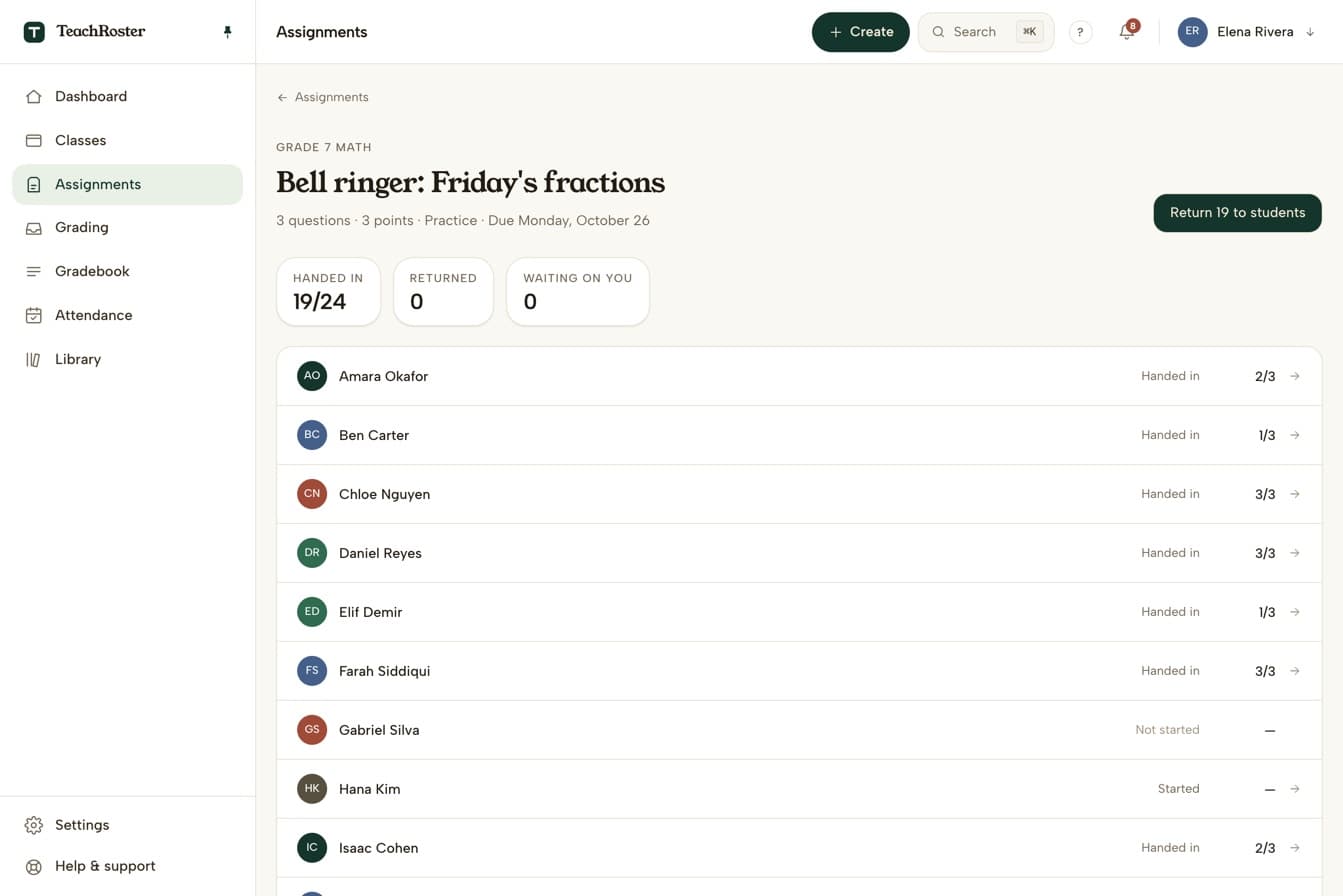
By the time the register is done, the scores are in. In the class below, 19 of 24 have handed in, three are still working, and two have not started. The students on 1 out of 3 are the first people to talk to, and if half the class missed the same question, that is the first five minutes of the lesson.
When bell ringers go wrong
- Students do not start. Usually the task needs explaining, which breaks the second rule. Make it something they have seen before; save new material for the lesson.
- It takes fifteen minutes. The task is fine; the review is too long. Go over only what most students got wrong.
- It turns into copying. Writing the date and the objective is not a bell ringer. If there is nothing to remember, there is nothing to learn from the answers either.
- Nobody reads the answers. Then it is a routine, not an assessment. Read five at random while the class works, or let a quiz mark itself and look at the list.
Questions teachers ask
What is a bell ringer in school?
A bell ringer is a short task waiting for students when they arrive — on the board, on a slip or on a screen — that they start straight away without instructions from the teacher. It usually takes three to five minutes and asks students to recall or apply something from a recent lesson.
What is the difference between a bell ringer and a do now?
Nothing important: they are two names for the same routine. "Do Now" is the name Doug Lemov uses in Teach Like a Champion; "bell ringer" and "warm-up" are common in US schools, and UK teachers usually say "starter" or "do now".
How long should a bell ringer take?
Three to five minutes for students to do it, and about five more to go over it. Lemov warns that a review which runs much longer turns the Do Now into the lesson and squeezes out the practice that should follow.
Should bell ringers be graded?
Usually not for accuracy. Some teachers give a mark for completing the week's bell ringers, which builds the habit, but grading the answers makes students guess cautiously instead of showing you what they have forgotten — which is the point of asking.
What are good bell ringer questions for high school?
Questions that make students retrieve, not copy: explain a term from last week in your own words, find the mistake in a worked example, answer one question from last lesson and one from last month, or say which of four items does not belong and why. Keep it to something every student can start alone.