12 retrieval practice activities that take ten minutes or less

Retrieval practice is asking students to pull something out of memory instead of putting it back in — a blank page, three questions, a flashcard answered before it is turned over. It is the cheapest thing a teacher can do that the research keeps saying works, and almost all of it needs nothing but paper.
Below are twelve ways to run it, each ten minutes or less, with how long it takes, what it needs, and what it tells you about your class. They run roughly from no preparation at all to a little. The research behind them, and how far apart to space them, comes after the list.
What retrieval practice is
Retrieval practice is any activity in which a student recalls information from memory without looking at it, and then checks. The act of retrieving strengthens the memory more than another look at the same material does, which is why researchers call it the testing effect even when no test is involved.
It is not a test in the sense students dread. A test measures learning; retrieval practice causes it. The difference is what happens to the result: here nothing is recorded, nobody is ranked, and the right answer arrives within minutes.
Why recalling beats rereading
In a 2006 study, Henry Roediger and Jeffrey Karpicke had students learn a short prose passage in different ways. A week later, the students who had read it once and then tried to recall it three times remembered about 61% of it. The students who had read it four times remembered about 40%. Five minutes after studying, the rereaders had looked better — and they were more confident they would remember.
Rereading feels like learning because the page is familiar. Recall feels like a struggle because it is the part that works.
Five years later, Karpicke and Janell Blunt set retrieval against concept mapping, which most teachers would call the more demanding task. Students who practised recalling a science text did better on the final test, including on questions that asked them to draw inferences rather than repeat facts back.
In 2013 John Dunlosky and four colleagues reviewed ten study techniques students commonly use. Two were rated high utility: practice testing and distributed practice. Highlighting and rereading — the two students lean on most — were rated low.
The classroom evidence agrees with the lab. A 2021 systematic review by Pooja Agarwal, Ludmila Nunes and Janell Blunt coded 50 experiments run in real schools and classrooms; 57% of the effects were medium or large, across ages, subjects and question formats. And in a 2014 study of more than 1,400 middle and high school students, 92% said retrieval practice helped them learn and 72% said it made them less nervous about tests.
Three rules that make any of these work
- Low stakes. Nothing goes in the gradebook. A student who knows the result counts will copy, guess or freeze; one who knows it does not will show you what they actually remember.
- Recall first, look second. Books closed and notes away until the answers are written. Checking is part of it, but only after the effort.
- Feedback in the same lesson. Go through the answers, or let students check against a key. A mistake practised without correction is a mistake learned.
Pitch matters too. Barak Rosenshine’s Principles of Instruction puts the most effective success rate during practice at about 80%. If everyone gets everything right, the questions are too easy to strengthen anything. If half the room is blank, you are not looking at a retrieval problem: it was not learned the first time, and it needs teaching again, not recalling.
Twelve retrieval practice activities
Each one comes with the three things worth knowing before you try it: how long it takes, what it needs, and the kind of lesson it suits.
1. Brain dump
Hand out blank paper. “Write down everything you remember about yesterday’s lesson on the water cycle — words, diagrams, examples, anything.” Three minutes, silence, no notes. Then students open their books and add what they missed in a different colour.
- Time
- 3–5 minutes
- Prep
- None — blank paper
- Best for
- The start of a lesson, any subject
The second colour is the useful part. It shows each student, and you walking the room, exactly what did not stick. If the same idea turns up in the second colour on most pages, that is tomorrow’s starter.

2. The two-minute starter quiz
Three to five short questions on the board as students come in, answered in silence. What matters is where the questions come from: one from last lesson, one from last week, one from last month. Some teachers call it a 1-1-1 starter.
- Time
- 2–5 minutes
- Prep
- Five minutes, once per lesson
- Best for
- A settled start to every lesson
Mark it together: read the answers out and let students tick their own. Nothing is collected. After a few weeks the older questions stop being a surprise, which is the point — students start expecting to need what they learned a month ago.
3. Flashcards, done properly
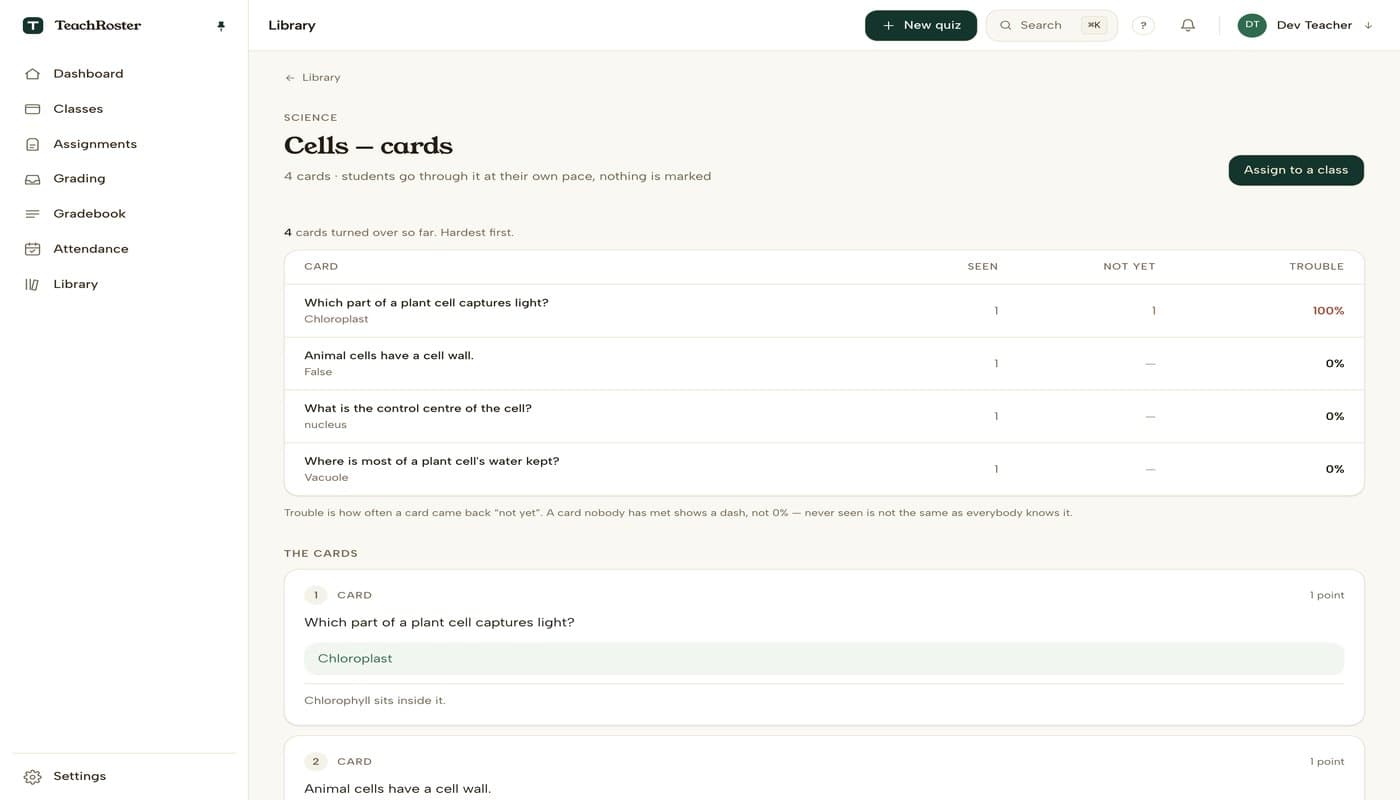
Flashcards are retrieval practice with the answer key built in, and most students use them in a way that takes the retrieval out. They glance at the front, flip at once, and nod. A card has to be answered — out loud or on paper — before it is turned over.
- Time
- 5–10 minutes
- Prep
- A deck per topic
- Best for
- Vocabulary, definitions, formulas, dates
- Say the answer before you flip. No answer, no flip.
- Two piles: knew it, and not yet. The not-yet pile comes round again in the same session until it is empty.
- Do not retire a card after one right answer. It comes back tomorrow, then in a few days, then in a week.
- One fact per card.A back that needs the word “and” is two cards.
The last rule is the one home-made decks break most. A card that asks for three things lets a student feel they know it when they can recall one of the three.
4. Two things
At the start of the lesson: “Write down two things you remember from last week’s lesson on fractions.” It takes a minute and no preparation at all, which is why it survives a bad week when everything else gets dropped.
- Time
- 1–2 minutes
- Prep
- None
- Best for
- Days with no time to prepare anything
Ask three or four students to read theirs out and write them on the board. You hear what the class thinks the lesson was about, which is not always what you thought you taught.
5. Mini whiteboards, all at once
Ask a question, give ten seconds, and on your signal everyone holds up their board at the same moment. The simultaneous reveal is what makes it retrieval rather than copying from a neighbour — and it is the only activity here where you see thirty answers in one glance.
- Time
- 3–5 minutes
- Prep
- A set of boards and pens
- Best for
- Checking the whole room mid-lesson
Rosenshine lists checking for understanding and requiring responses from every student among the habits of the most effective teachers. Hands up gets you the answers of the five who volunteer. Boards get you everyone’s.
No boards? A sheet of paper in a clear plastic wallet and a dry-wipe pen does the same job for a fraction of the price.
6. The hinge question
One multiple-choice question, asked at the point in a lesson where you have to decide whether to move on. Every wrong option is a mistake students really make, so the letter each student picks tells you which misunderstanding they have, not only that they are wrong.
- Time
- About 2 minutes
- Prep
- One well-built question
- Best for
- Deciding whether to move on
Dylan Wiliam, who popularised the idea, suggests students should be able to answer within two minutes and you should be able to read the whole room in about thirty seconds — fingers held up for A, B, C or D is enough. For example: Which is larger, 3/4 or 5/8? A) 5/8, because 8 is bigger than 4. B) 3/4. C) They are equal. D) You cannot compare them. A student who holds up A is comparing the bottom numbers, and now you know exactly what to fix.
7. The retrieval grid
Twelve questions in a grid on one slide, colour-coded by age: this week’s worth one point, last month’s two, last term’s three. Students pick which to answer in eight minutes and add up their points.
- Time
- 8–10 minutes
- Prep
- About twenty minutes, then reusable
- Best for
- Revision weeks and mixed-attainment classes
The points do the spacing for you: older material is worth more, so students go looking for it. Keep the grid and swap a few squares each week rather than building a new one every time.
8. Label the blank diagram
Show a diagram the class has already studied — the heart, a volcano, a plant cell, a river basin — with the labels removed. Students label it from memory, then compare with the original.
- Time
- 3–5 minutes
- Prep
- Delete the labels from a diagram you have
- Best for
- Science, geography, anything drawn
It retrieves both the words and where they belong, which is how diagrams tend to be examined. Point arrows at the parts rather than numbering them, or the numbers become the cue.
9. Write it, then pair it
Students answer a question alone and in writing first — a minute of silence — and only then compare with a partner to fill the gaps. It is think-pair-share with the thinking made compulsory.
- Time
- 4–6 minutes
- Prep
- One open question
- Best for
- Getting quieter students to commit to an answer
The order is the whole technique. Discuss first and the confident student does the retrieving while the partner listens. Write first and both of them have to.
10. The cumulative homework quiz
A short weekly quiz set as homework, where some questions come from this week and some from earlier units — three new and two old, say. It moves retrieval out of lesson time altogether.
- Time
- 10 minutes at home
- Prep
- Ten minutes a week
- Best for
- Keeping earlier units alive across a term
This is where software earns its place. Marking thirty five-question quizzes by hand every week is the reason most teachers give up on it; if the multiple-choice and true/false questions mark themselves, the only cost left is writing them.
11. Here is the answer — what was the question?
Give students an answer and ask for three questions it could be the answer to. “1/2”: what is 2/4 simplified, what fraction of a pizza is left after half is eaten, what is 5/10. “Chloroplast”: where does photosynthesis happen, which part of a plant cell is green.
- Time
- 3–5 minutes
- Prep
- One answer on the board
- Best for
- Stretching stronger students; maths and science
It is harder than it looks, because the student has to retrieve what the answer connects to rather than the answer itself. It also produces questions you can reuse in the next starter.
12. Explain it in 25 words
No notes: explain yesterday’s idea in exactly twenty-five words, or to a student two years younger, or in three sentences. The limit makes students decide what matters, which means retrieving the whole idea and not just its keywords.
- Time
- About 5 minutes
- Prep
- None
- Best for
- The end of a unit, before a longer written answer
Read two or three aloud. The weak ones are usually weak in the same way — a missing step, a muddled term — and that is worth two minutes of the next lesson.
All twelve at a glance
| Activity | Time | Prep | What it tells you |
|---|---|---|---|
| Brain dump | 3–5 min | None | What did not stick, student by student |
| Two-minute starter | 2–5 min | 5 min | Whether older material has survived |
| Flashcards | 5–10 min | A deck | Which facts keep coming back wrong |
| Two things | 1–2 min | None | What the class thinks the lesson was about |
| Mini whiteboards | 3–5 min | Boards | Everyone's answer at once |
| Hinge question | About 2 min | One question | Which misunderstanding, not just who is wrong |
| Retrieval grid | 8–10 min | 20 min, reusable | How far back students can reach |
| Blank diagram | 3–5 min | Remove the labels | The vocabulary and where it goes |
| Write, then pair | 4–6 min | One question | What quieter students actually think |
| Cumulative homework | 10 min at home | 10 min a week | What is retained across a term |
| Question the answer | 3–5 min | One answer | Whether ideas are connected |
| Explain in 25 words | About 5 min | None | Whether they hold the whole idea |
How far apart to space them
When you review matters almost as much as whether you do. In 2008 Nicholas Cepeda and colleagues taught more than 1,350 people a set of facts, reviewed them after gaps of up to three and a half months, and tested them up to a year later. The best gap depended on how long the knowledge had to last: roughly 20–40% of the wait for a test a week away, falling to 5–10% of the wait for a test a year away.
In a classroom that becomes a simple habit: review new material within a few days, again after a week or two, and again a month or so later. The 1-1-1 starter does this without a plan. A flashcard deck that brings a known card back after a day, then three days, then a week does it on its own.
Cramming works for the test on Friday. Spacing works for the one in June.
Five ways it quietly stops working
- Grading it. The moment a retrieval quiz counts, students protect the score instead of showing you the gap.
- Only ever reviewing yesterday. Recalling something learned a day ago is easy and does little. The older question is the one doing the work.
- Leaving the book open. If the answer is in view, nothing is being retrieved.
- Skipping the answers. Retrieval without feedback can harden a wrong answer. Check in the same lesson, every time.
- Only multiple choice.Recognising the right option is easier than producing it. Mix in free recall — a brain dump, a blank diagram, a question with no options at all.
Doing it with TeachRoster
Every activity above works with paper, and paper is often quicker. Where a tool helps is with the parts that make teachers stop after three weeks: writing the questions, marking them, and remembering what to bring back and when.
In TeachRoster, which we make, you can upload your own notes or a PDF and get a flashcard deck or a short quiz drafted from it, which you edit before any student sees it. Multiple-choice and true/false answers mark themselves the moment a student hands in. A student’s deck brings a card they knew back after 1 day, then 3, 7, 16 and 35 days — gaps that widen each time, on a fixed ladder you can check against what a student sees — and a card they missed comes back in the same session. Decks are never graded, and the deck page shows which cards the class keeps getting wrong. Students join with a class code and never make an account.
It is free for teachers. It is also new, and a stack of index cards has been doing this job for a very long time.
Questions teachers ask
What is retrieval practice in the classroom?
Retrieval practice is any activity in which students recall information from memory without looking at their notes, then check their answers — a brain dump, a short quiz, flashcards or a blank diagram. Recalling strengthens memory more than rereading does, and it works best when it is low-stakes, spaced over time, and followed by quick feedback.
How often should teachers use retrieval practice?
A few minutes in most lessons does more than a long session once a week. A common pattern is a two-minute starter with one question from last lesson, one from last week and one from last month. Cepeda and colleagues (2008) found the best gap before a review is roughly 20–40% of the wait for a test a week away, falling to 5–10% for a test a year away.
Should retrieval practice be graded?
No. Retrieval practice works best when nothing rides on it. Once the result counts, students copy, guess or leave answers blank to protect the score, and you lose the one thing the activity was for: an honest picture of what they have forgotten. Check the answers in the same lesson and keep the scores out of the gradebook.
Is retrieval practice the same as a test?
Not in purpose. A test measures what students know; retrieval practice is used to make them remember it. The activity can look the same — questions answered from memory — but retrieval practice is ungraded, frequent, and followed straight away by the answers.
Does retrieval practice work for all ages and subjects?
The classroom evidence says it works widely. A 2021 systematic review by Agarwal, Nunes and Blunt coded 50 experiments run in real schools and classrooms and found benefits across education levels, subjects and question formats, with 57% of the effects medium or large.
What is the difference between retrieval practice and spaced practice?
Retrieval practice is how students review: by recalling rather than rereading. Spaced practice is when: spreading reviews over days and weeks instead of cramming them into one sitting. They work best together, and a quiz on last month's topic is both at once.
How long should a retrieval practice activity take?
Most good activities take between two and ten minutes. The point is short, frequent recall rather than a long session: a two-minute starter at the beginning of most lessons does more than a forty-minute review once a term.
Sources
- Roediger, H. L., & Karpicke, J. D. (2006). Test-enhanced learning: Taking memory tests improves long-term retention. Psychological Science, 17(3), 249–255.
- Karpicke, J. D., & Blunt, J. R. (2011). Retrieval practice produces more learning than elaborative studying with concept mapping. Science, 331(6018), 772–775.
- Dunlosky, J., Rawson, K. A., Marsh, E. J., Nathan, M. J., & Willingham, D. T. (2013). Improving students’ learning with effective learning techniques. Psychological Science in the Public Interest, 14(1), 4–58.
- Agarwal, P. K., Nunes, L. D., & Blunt, J. R. (2021). Retrieval practice consistently benefits student learning: A systematic review of applied research in schools and classrooms. Educational Psychology Review, 33.
- Agarwal, P. K., D’Antonio, L., Roediger, H. L., McDermott, K. B., & McDaniel, M. A. (2014). Classroom-based programs of retrieval practice reduce middle school and high school students’ test anxiety. Journal of Applied Research in Memory and Cognition, 3(3), 131–139.
- Cepeda, N. J., Vul, E., Rohrer, D., Wixted, J. T., & Pashler, H. (2008). Spacing effects in learning: A temporal ridgeline of optimal retention. Psychological Science, 19(11), 1095–1102.
- Rosenshine, B. (2012). Principles of instruction: Research-based strategies that all teachers should know. American Educator, 36(1), 12–19, 39.
- Wiliam, D. (2015). Designing great hinge questions. Educational Leadership, September 2015.