12 formative assessment examples, and how to read the answers by tomorrow
Formative assessment is any check on learning whose result changes what you teach next. That definition is the whole test for the examples below. A beautifully designed activity whose answers nobody reads is not formative assessment; a scrawled question on a sticky note that decides tomorrow’s starter is.
Most lists of formative assessment examples stop at the name of the technique. The question a teacher actually has is narrower: what will this tell me, and can I read it for thirty students before I plan the next lesson? So each of the twelve below comes with how long it takes, what it needs, and what to do with what you find.
Formative or summative: the one-sentence difference
Formative assessment happens while learning is still going on and is used to adjust the teaching; summative assessment happens at the end and measures what was learned. The same five questions can be either. If the result changes Thursday’s lesson, it was formative. If it goes into the gradebook as the final word on the unit, it was summative.
That settles a question teachers search for more than you might expect: is an exit ticket formative or summative? It is formative. An exit ticket is a short check at the end of a lesson whose answers decide what you teach next, and it is not graded. The fifteen exit ticket questions post goes into what to ask.
The idea is older than the jargon. Paul Black and Dylan Wiliam made the case for it in a 1998 review of the research, and in the UK the same practice usually goes by “assessment for learning”, or AfL. Barak Rosenshine’s widely shared principles of instruction put it more plainly: ask a large number of questions, and check the responses of all students.
The test is not what the activity looks like. It is whether anyone reads the answers and teaches differently because of them.
Twelve formative assessment examples
1. Exit ticket
- Time
- 3 minutes
- Prep
- One question on a slip or a screen
- Best for
- The end of any lesson
One question on the single most important idea of the lesson, answered alone in the last three minutes. Not “what did you learn today?” — that gets you a list of topics — but a question that only someone who understood could answer. Read them standing by the door and sort them into three piles: got it, nearly, not yet. The size of the third pile decides how tomorrow starts.
2. Hinge question
- Time
- 2 minutes
- Prep
- One multiple-choice question with deliberate wrong answers
- Best for
- Halfway through a lesson, before moving on
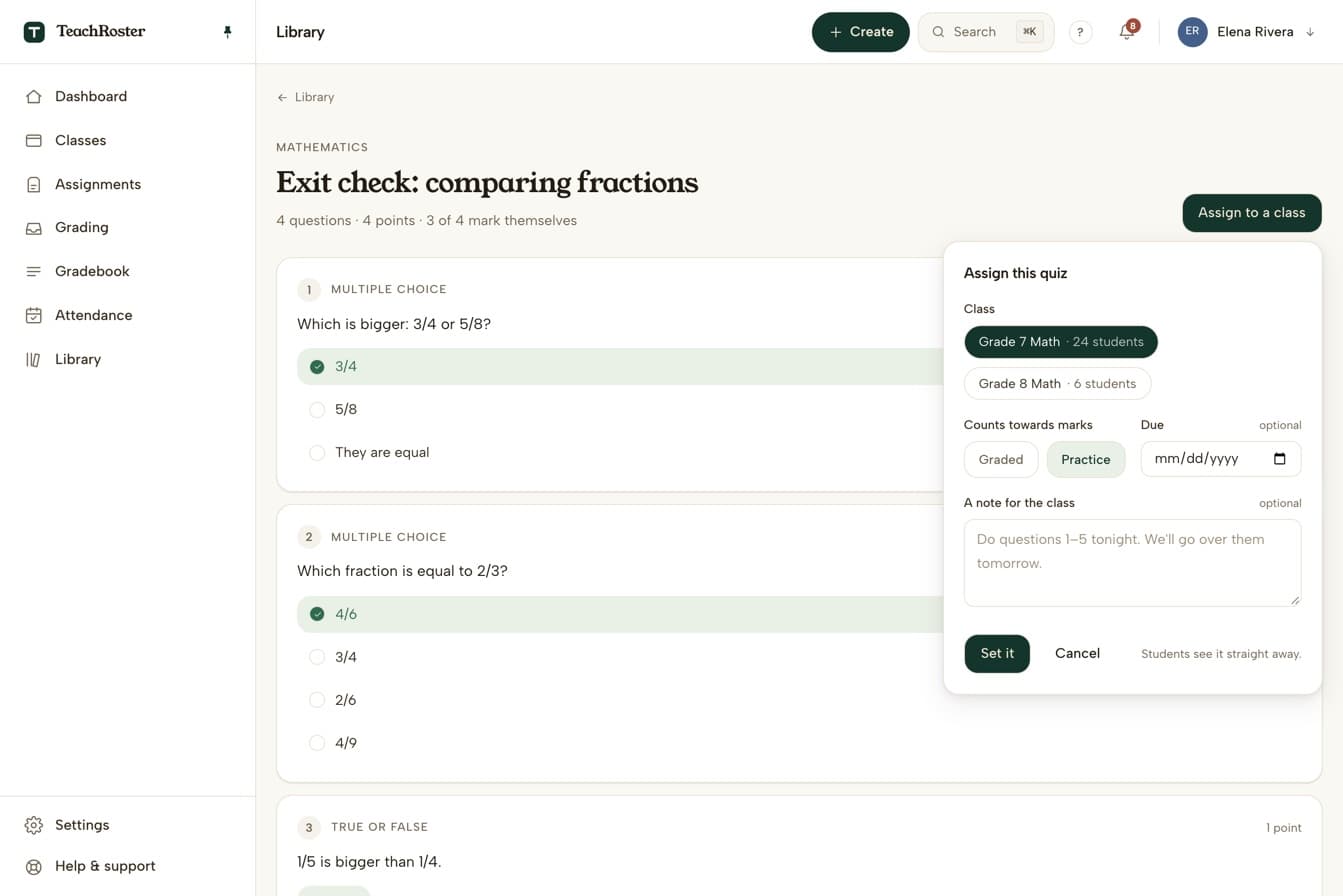
Dylan Wiliam’s term for a single question asked at the point where the lesson turns: carry on, or go back. It is multiple choice, and every wrong option is a specific misconception. “Which is bigger, 3/4 or 5/8?” A student who picks 5/8 is comparing the bottom numbers; one who says they are equal is guessing. Everyone answers at once, and you decide in thirty seconds. The question has to be good enough that a right answer for a wrong reason is unlikely.
3. Mini whiteboards
- Time
- 1 minute a question
- Prep
- A board and pen per student
- Best for
- Steps of a procedure, spellings, quick calculations
Ask, give thinking time, then “three, two, one, show me”. Every board goes up together, so nobody copies the quickest hand, and you can scan a room of thirty in a few seconds. The weakness is that nothing is kept: write the names of the four students who need you on a sticky note before the boards are wiped.
4. ABCD cards
- Time
- 1 minute
- Prep
- A set of four letter cards per student, or fingers
- Best for
- Multiple choice without devices
The low-tech version of a hinge question. Each student holds up A, B, C or D (or one to four fingers against their chest, so neighbours cannot see). It only works if the options are written to reveal thinking; four options where three are obviously silly tell you nothing.
5. No hands up
- Time
- Throughout a lesson
- Prep
- None
- Best for
- Discussion, questioning, any subject
Ask the question, pause, then name who answers. Hands up gives you a sample of the students who already know; naming students — Doug Lemov calls it Cold Call — gives you a sample of the room. Ask two or three students the same question before saying who was right, and ask the next one whether they agree and why.
6. A short quiz that marks itself
- Time
- 5 minutes
- Prep
- Three to five questions
- Best for
- Classes with devices, checking a whole topic
Three to five multiple-choice or true/false questions, done on phones or laptops in the last five minutes, in any tool that marks them the moment a student hands in. The advantage over paper is simply time: the scores are ready before the students have left the room, so the reading is done by the time you sit down to plan. Add one short-answer question for the idea that matters most, and read those answers yourself.
7. Brain dump
- Time
- 3 minutes
- Prep
- None
- Best for
- The start of a lesson, before a test
“Write down everything you remember about photosynthesis.” Books closed, three minutes, then compare with a partner and add in a different colour what you had forgotten. It is retrieval practice as much as assessment — students know it as the blurting method — and the different-colour additions show you exactly what fell out of memory. There is more on this in twelve retrieval practice activities.
8. First step only
- Time
- 2 minutes
- Prep
- One problem
- Best for
- Maths and science procedures
Put a problem on the board and ask students to write only the first line of their working. You are not checking whether they can finish; you are checking whether they know how to start, which is where most students who are stuck are stuck. Ten students who all began by adding the denominators is one short reteach, not ten separate ones.
9. True or false, and why
- Time
- 3 minutes
- Prep
- Three statements, one built on a common misconception
- Best for
- Concepts with well-known misconceptions
“Heavier objects fall faster. True or false, and one sentence why.” The true/false part is quick to read; the sentence is where the information is. A student who writes “false” with a reason that is also wrong has learned the answer, not the idea.
10. 3-2-1
- Time
- 4 minutes
- Prep
- A slip with three boxes
- Best for
- The end of a unit or a long lesson
Three things you learned, two you are unsure about, one question you still have. The first box is the least useful; students list the headings. The middle box is the one to read, because it is the rare place a student tells you in writing what they do not understand. Give the slip a single focus (“three things about how to compare fractions”) or the answers drift.
11. Confidence, then a question
- Time
- 1 minute
- Prep
- None
- Best for
- Alongside any of the others
Traffic lights and thumbs up tell you how students feel, not what they know, and the two are often different. Use the rating, but pair it with a question: “How sure are you, one to four? Now answer this.” The students who are confident and wrong are the ones a plain confidence check would never find.
12. Explain it to a partner
- Time
- 3 minutes
- Prep
- One prompt
- Best for
- Concepts, vocabulary, language lessons
“Explain to your partner why 2/4 and 1/2 are the same.” Then walk, and listen to three pairs. You are listening for the vocabulary they use and where the explanation falls apart. It gives you less than the written checks, but it is the only one on this list that shows you how students talk about an idea, which is often where the misunderstanding is.
All twelve at a glance
| Example | Time | Does everyone answer? | Kept afterwards? |
|---|---|---|---|
| Exit ticket | 3 min | Yes | Yes, on paper or screen |
| Hinge question | 2 min | Yes, at once | No |
| Mini whiteboards | 1 min each | Yes, at once | No |
| ABCD cards | 1 min | Yes, at once | No |
| No hands up | Ongoing | A sample | No |
| Self-marking quiz | 5 min | Yes | Yes, already marked |
| Brain dump | 3 min | Yes | Yes, if collected |
| First step only | 2 min | Yes | Yes |
| True or false, and why | 3 min | Yes | Yes |
| 3-2-1 | 4 min | Yes | Yes |
| Confidence + question | 1 min | Yes | Rarely |
| Explain to a partner | 3 min | Yes, aloud | No |
Reading thirty answers before tomorrow
The examples are the easy part. What decides whether formative assessment happens in a real week is whether the reading fits in the gap between the bell and the next lesson. Three habits make it fit.
- Sort, do not mark.Three piles — got it, nearly, not yet — is a glance per slip, not a reading. Nobody needs a score on a formative check; you need to know which pile is biggest.
- Look for the shared wrong answer. Eight students who are wrong in eight different ways need eight conversations. Eight students who are wrong in the same way need one re-explanation, and that is the one to plan.
- Decide the first ten minutes, not the whole lesson. If the “not yet” pile is a third of the class, open with a reteach and a fresh question on the same idea. If it is three students, they get five minutes with you while the rest start the new work.
A check you have no time to read is not formative assessment yet. If the reading never happens, ask fewer questions, not more.
Formative assessment examples and strategies
“Strategies” and “examples” get used interchangeably, but there is a useful difference. Black and Wiliam (2009) describe five key strategies: making clear what success looks like; designing discussions and tasks that draw out evidence of understanding; giving feedback that moves learning forward; getting students to learn from one another; and getting students to own their own learning. The twelve examples above are mostly ways of doing the second. Number 12, explaining to a partner, touches the fourth; number 11, rating confidence, touches the fifth.
Keep it out of the gradebook
A graded check gives students a reason to hide what they do not understand, and hiding it is the one thing a formative check cannot survive. Mark it, give it back, talk about it — and keep it away from the average that ends up on a report.
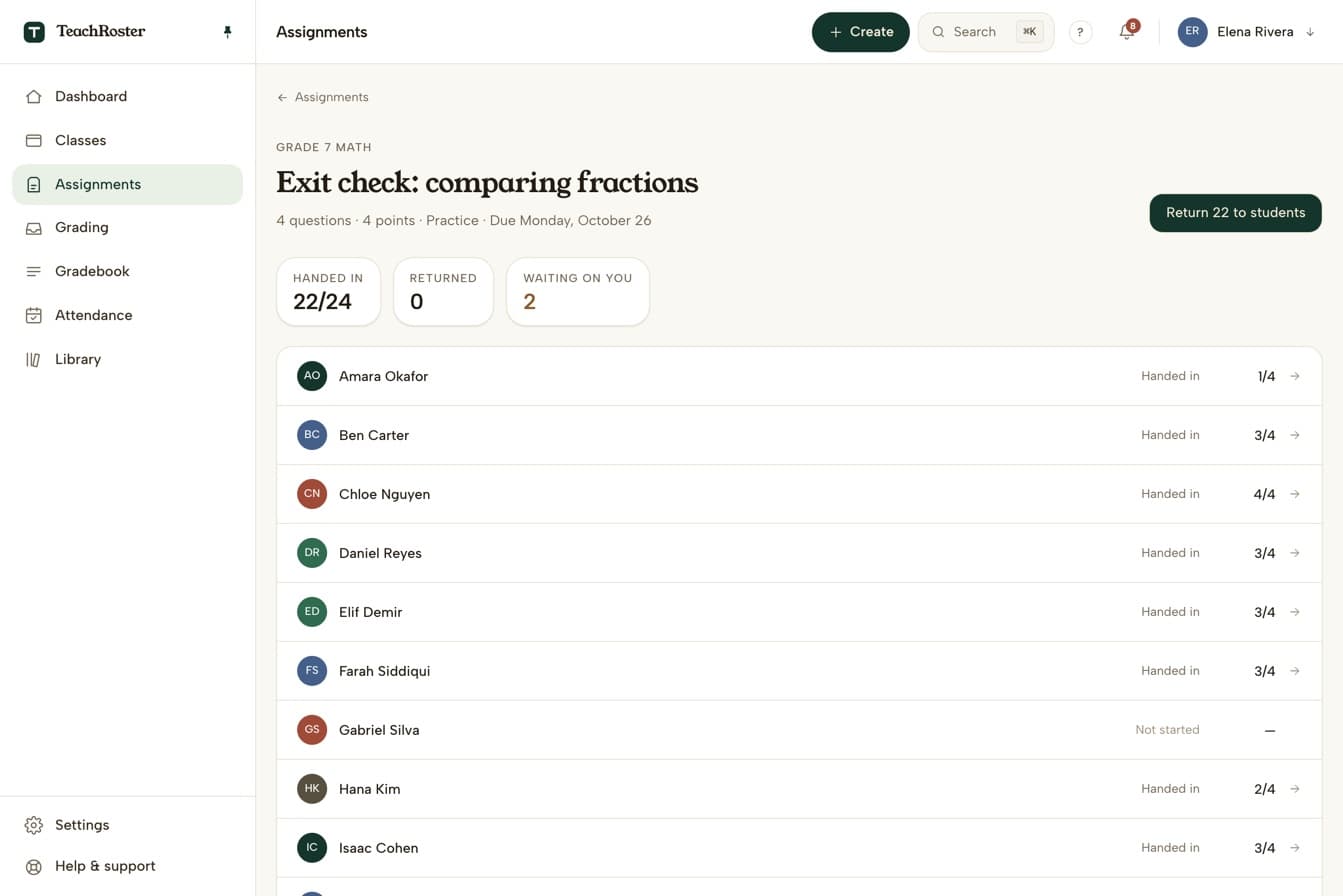
I build TeachRoster, so read this as a description of one way to do it. When you assign a quiz there is a choice between Graded and Practice. Practice work is marked and returned like anything else, but it never appears in the gradebook, so a four-question exit check can go to the class without anyone worrying about their average.
Multiple choice and true/false mark themselves when a student hands in. By the time the class has left, the list shows who handed in and each score, so the three students on 1 out of 4 are visible before you have read a single slip. The list is by student rather than by question, so to find the shared wrong answer, open the papers of the students who scored lowest and look at which question they missed.
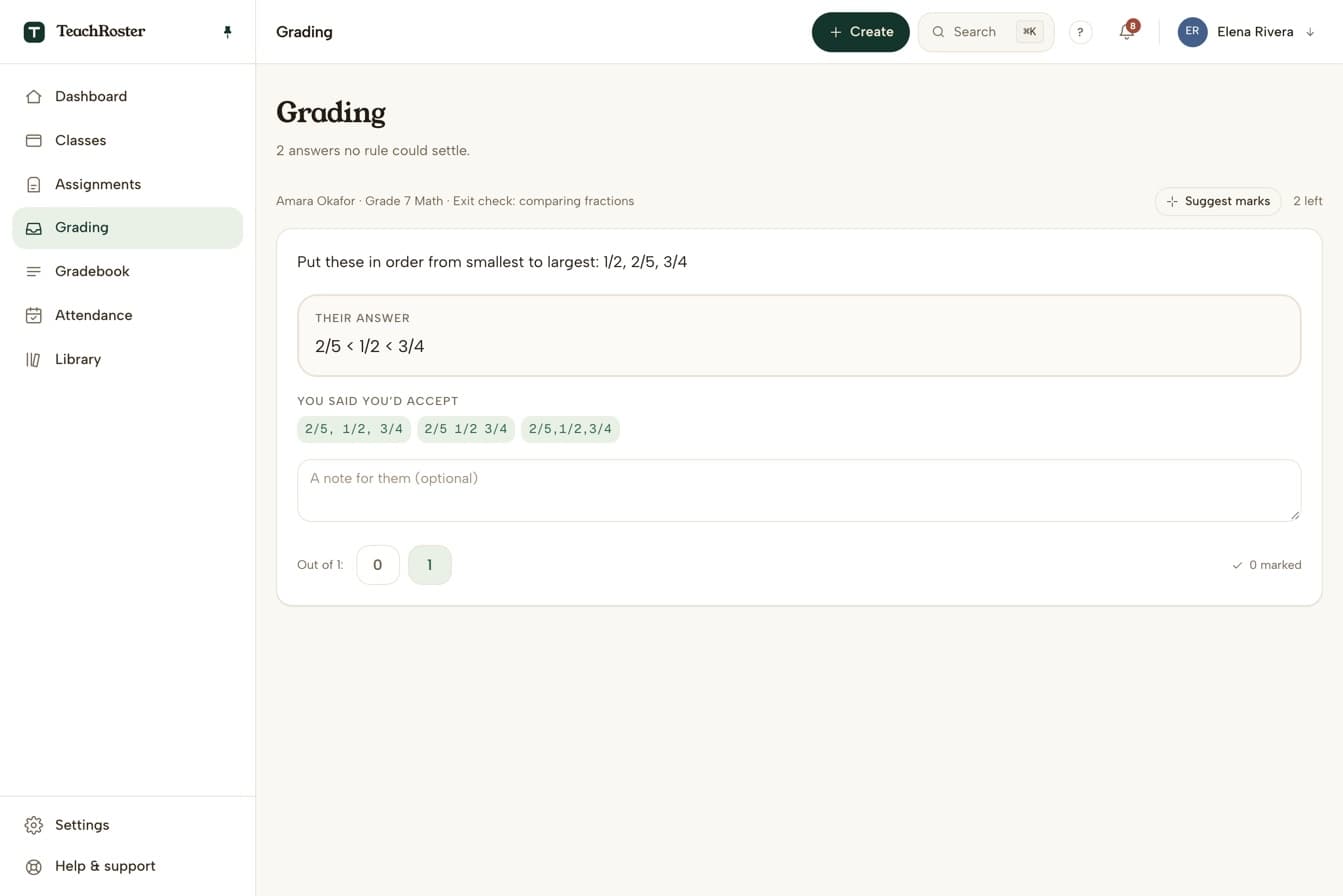
The short-answer question is the one to read yourself. If a student’s answer matches one of the forms you said you would accept, it is marked; if it does not, it is not marked wrong. It waits for a person. Below, a student has written the three fractions in the right order with less-than signs, which is correct and not on the list — exactly the kind of answer a rule should not decide.
None of the twelve examples needs software. Mini whiteboards and a pile of paper slips will do most of this; the app earns its place on the days when the reading would not otherwise happen.
Questions teachers ask
What are some examples of formative assessment?
Exit tickets, hinge questions, mini whiteboards, ABCD cards, cold calling with no hands up, a short quiz that marks itself, a brain dump, asking for only the first step of a problem, true-or-false statements with a reason, 3-2-1 slips, a confidence rating paired with a question, and listening in while students explain an idea to a partner. What makes each one formative is that its result changes what you teach next.
Is an exit ticket formative or summative?
An exit ticket is formative assessment: a short check at the end of a lesson whose answers decide what you teach tomorrow. It is not graded. It would only become summative if you graded it and recorded it as a final measure of what a student had learned, which defeats its purpose.
What is the difference between formative and summative assessment?
Formative assessment happens during learning and is used to adjust teaching; summative assessment happens at the end of a unit or course and measures what was learned. The same quiz can be either — what decides it is whether the result changes your next lesson or goes into the gradebook as a final mark.
Should formative assessment be graded?
Usually not. A graded check gives students a reason to hide what they do not understand, which is exactly the information a formative check exists to collect. Mark it, give it back, and keep it out of the gradebook.
What are the five key strategies of formative assessment?
Black and Wiliam (2009) set out five: clarify and share what success looks like; engineer classroom discussions and tasks that draw out evidence of understanding; give feedback that moves learners forward; activate students as learning resources for one another; and activate students as owners of their own learning. The twelve examples in this post are mostly ways of doing the second.
Sources
- Black, P., & Wiliam, D. (1998). Assessment and classroom learning. Assessment in Education: Principles, Policy & Practice, 5(1), 7–74.
- Black, P., & Wiliam, D. (2010). Inside the black box: Raising standards through classroom assessment. Phi Delta Kappan, 92(1), 81–90. First published 1998.
- Black, P., & Wiliam, D. (2009). Developing the theory of formative assessment. Educational Assessment, Evaluation and Accountability, 21(1), 5–31.
- Rosenshine, B. (2012). Principles of instruction: Research-based strategies that all teachers should know. American Educator, 36(1), 12–19, 39.