AI grading: what to automate, and what you should never delegate

Every conversation about AI grading collapses into the same two camps. One says marking is drudgery and should be automated to zero. The other says marking is teaching and must never be touched. Both are describing something real, and both are describing a different half of the pile on your desk.
The useful question is not whether to automate grading. It is which specific marking task you are talking about, because the honest answer changes completely between them. A multiple-choice quiz and a first draft of an essay are not the same job wearing different clothes. They are different jobs that happen to end in a number.
Three tiers, not two
Sort the pile by what the marking actually is, and it separates cleanly into three tiers. They are wildly different sizes, which is the part that makes the whole argument workable.
Tier one: automate it completely
Multiple choice. True or false. Fill in the blank with a single accepted answer. Matching. Anything where a correct response can be written down in advance.
There is no argument for marking these by hand, and the argument is not about time. A machine is more consistent than you are. It does not get more generous at question 12 of 35, it does not get harsher after a bad meeting, and it does not skip a line and mark the wrong row. Teachers are excellent at judgement and mediocre at repetitive comparison, particularly at nine in the evening. That is not a character flaw, it is how attention works.
There is a second, quieter benefit. Marking that happens on submission means a student who finishes on Tuesday night gets their score on Tuesday night, while they still remember what they were thinking. A score returned on Friday is an administrative event. A score returned immediately is feedback.
this tier is not “AI” in any meaningful sense — it is string comparison with better marketing
Tier two: let it suggest, you decide
Short answers. One-paragraph explanations. Show-your-reasoning questions. Here a model can genuinely help, and here it is also confidently wrong often enough that unsupervised marking is indefensible.
The distinction that makes this tier safe is small and easy to lose: a suggested score is not a score. It is a proposal with a number attached, and it becomes a grade at the moment a teacher accepts it. A system that blurs those two things is not saving you work, it is transferring a decision away from you and hoping you do not notice.
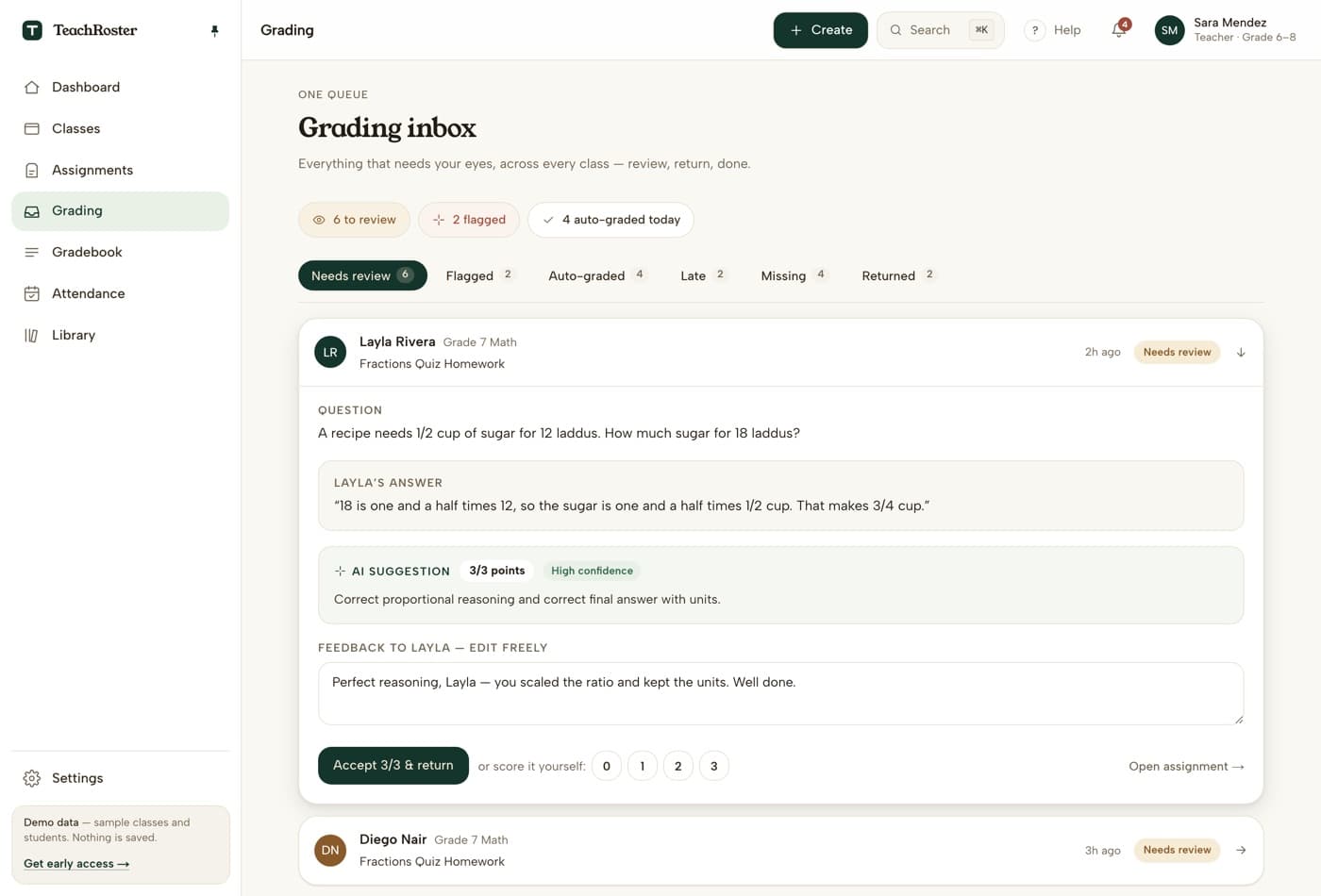
What to actually do with a confidence level
Confidence is the feature that turns a suggestion from a liability into a triage tool. It is not telling you the answer is right. It is telling you how much of your attention this one deserves.
| Confidence | What it usually means | What to do |
|---|---|---|
| High | The answer closely matches an expected response, or is plainly blank or off-topic. | Skim and accept in a batch. Spot-check two or three across the set. |
| Medium | Roughly right, but phrased unusually, partially complete, or arguing a different route. | Read the answer, not the suggestion. This is where partial credit decisions live. |
| Low | The model cannot map the answer onto anything it expected. | Read every one. This band contains both your weakest and your most interesting students. |
Notice what that table implies about time. You are not reading thirty-five answers, you are reading the eight the system could not be sure about. That is a genuine saving, and it does not require you to trust anything you have not seen.
The failure mode nobody advertises
Automated marking is not randomly wrong. It is wrong in a specific, predictable direction: it penalises the student who solved the problem a different way.
Consider a genuine example. The question:
a recipe needs 1/2 cup of sugar for 12 muffins. how much sugar for 18?
The expected route is to scale by 18/12. A student writes: “18 is one and a half times 12, so the sugar is one and a half times 1/2 cup. That makes 3/4 cup.” Correct, well reasoned, and phrased nothing like a worked solution. A different student writes “3/4” and nothing else.
A marking model reading for the expected procedure can rate the second answer above the first. The first student did more thinking and showed it. If you accept suggestions without reading, you have just taught your strongest reasoner that explaining themselves costs marks.
The students most likely to be marked unfairly by a machine are the interesting ones.
The same mechanism hits students working in their second language, whose phrasing is further from the expected wording for reasons that have nothing to do with whether they understand the maths. In a bilingual classroom in Madrid, or a Texas district where a third of the room speaks Spanish at home, this is not an edge case. It is a large part of the room.
Tier three: never hand this over
Some marking is not a measurement task at all. Automating it does not save time, it deletes the thing being done.
- Work where the comment is the point. A first draft of a piece of writing. The grade is nearly irrelevant; what the student does next depends entirely on which two sentences you chose to respond to.
- Anything measuring effort or progress. A model sees this submission. It does not know that this student has produced nothing for three weeks and that this paragraph is a breakthrough.
- High-stakes final marks. Reports, certifications, anything a student or a parent can appeal. Not because the model is necessarily worse, but because you must be able to explain and defend every one of those numbers in a meeting.
- The student you are worried about. If a name in the queue makes you pause, that is you noticing something. Read it yourself.

A ten-minute routine
The theory is easy. Here is what it looks like on a Wednesday with thirty minutes before your next class.
| Minutes | What you do |
|---|---|
| 0–1 | Open the queue. Tier one already marked itself; ignore it entirely. |
| 1–3 | Filter to low confidence. Read those properly. Override freely. |
| 3–6 | Work the medium band. Fix partial credit; rewrite feedback where the wording is generic. |
| 6–8 | Skim high confidence. Spot-check three. Accept the rest as a batch. |
| 8–10 | Return the whole set at once, so the class gets feedback together rather than in a trickle. |
The point of automating tier one is not to spend less time on marking. It is to spend the same ten minutes on the twelve pieces of work where your attention changes something.
What to tell students and parents
Say it plainly and say it first, because the version they hear from someone else will be worse. Three sentences are usually enough: which question types are marked automatically, that written answers are reviewed by you before any mark is final, and that their work is not used to train anybody’s AI model.
Being specific also protects you. “A computer marks the multiple choice and I mark everything else” is a claim a parent can understand and you can defend. “We use AI to help with grading” invites exactly the question you do not want in a meeting.
What to demand of any tool that does this
- Tell you what was auto-graded and what was suggested. Those are not the same event.
- Show a confidence level, and make the low-confidence work easy to find.
- Let you override any score in one action, without a dialogue arguing with you.
- Never send anything to a student until you press return.
- Be clear in writing that student work is not used to train public models.
If a tool cannot answer those five, it is not asking to save you time. It is asking you to trust it, which is a different request entirely, and one you should charge more for.
Questions teachers ask
Should teachers use AI to grade student work?
For questions with one correct answer, yes — a machine is more consistent than a tired human and returns the score immediately, while the student still remembers their reasoning. For written answers, use it to suggest a score you review rather than to decide one. For work where the comment is the point, such as a first draft, do not automate it at all: the grade is nearly irrelevant and the feedback is the whole exercise.
How accurate is AI grading on short answers?
Accurate enough to be useful and wrong often enough that unsupervised marking is indefensible. More importantly, it is not randomly wrong — it systematically under-marks answers that reach the right conclusion by an unexpected route, or that are phrased unusually because the student is working in their second language. That is why a confidence level matters more than a headline accuracy figure: it tells you which answers to read yourself.
Can AI grade essays?
It can produce a number for an essay, which is not the same as grading one. Essays are usually marked to develop a writer, and that work is the comment rather than the score. Use automated marking for the objective portion of an assessment and keep the extended writing for yourself, or the feedback loop that makes the writing improve stops existing.
Do students and parents need to be told that AI is involved in marking?
Tell them before anyone asks. Three sentences usually cover it: which question types are marked automatically, that written answers are reviewed by a teacher before any mark is final, and that student work is not used to train public AI models. Being specific is also what protects you, because a vague statement invites exactly the question you do not want in a meeting.
What should I check before trusting an AI grading tool?
Five things. It should distinguish what was auto-graded from what was suggested; show a confidence level and make low-confidence work easy to find; let you override any score in a single action; never return anything to a student until you press return; and state in writing that student submissions are not used to train public models. A tool that cannot answer those is asking for trust rather than offering time.
Is TeachRoster's grading free for teachers?
Yes, free. The grading inbox is fully clickable in the demo on sample submissions, so you can see the suggestions, the confidence levels and the return flow before creating anything.