9 flashcard games for the classroom, and the rule that makes them work
Most flashcard games are really speed contests. The student who knows the answer shouts it, everyone else waits, and by the end the three quickest people in the room have had a great revision session. The games below are chosen the other way round: every student answers every card, out loud or on paper, before anyone sees the back.
There are nine, from no preparation to a little. After them comes the part that matters more than which game you pick — how far apart to play them, and why students are so sure cramming works when it does not.
Two rules that make any game work
Answer before you turn it over.A flashcard read front then back is just a very small worksheet. The memory work happens in the second or two of trying to recall the answer, even when the attempt fails. Say it, write it, or point at it — but commit before the card flips.
Do not drop a card the first time it is right.When Wissman, Rawson and Pyc surveyed 374 students about how they used flashcards, the most common answer to “when has a card been studied enough?” was “when I get it right.” In an earlier experiment, Kornell and Bjork found that letting students drop the cards they felt they knew had small but consistently negative effects on learning. A card got right once is a card the student has just started to learn.
The nine games
1. Quiz-Quiz-Trade
- Time
- 8–10 minutes
- Prep
- One card per student
- Best for
- Whole class, movement, any age
A cooperative learning structure from Kagan, and the best one here for a restless class. Everyone gets one card. Students pair up; one quizzes the other with their card, coaches them if they are wrong, then they swap roles. Then they trade cards and find a new partner. In ten minutes each student answers a dozen different cards and teaches one of them several times over.
Tip: stop the room after five minutes and ask “which card has nobody been able to answer?” That is your reteach for tomorrow.
2. Three piles
- Time
- 5–10 minutes
- Prep
- A deck per pair
- Best for
- Pairs, before a test
In pairs, one student reads the front, the other answers. Each card goes into one of three piles: knew it straight away, got there slowly, and not yet. When the deck runs out, go again with the last two piles only, then the not-yet pile only, until it is empty. Then shuffle all three piles back together tomorrow — because a pile of cards known today is not a pile known on Friday.
3. The Leitner box
- Time
- 5 minutes, most lessons
- Prep
- A shoebox with dividers, or five envelopes
- Best for
- Individuals, long topics, language vocabulary
Described by Sebastian Leitner in the 1970s and still the simplest way to build spacing into flashcards without a timetable. Cards live in a row of boxes. Every card starts in box 1. Get it right and it moves one box along, to be reviewed less often. Miss it and it goes all the way back to box 1. The cards a student finds hardest are the ones they see most; the easy ones drift to the end and come back just before the test.
4. Around the World, fixed
- Time
- 10 minutes
- Prep
- A class deck
- Best for
- Younger classes, quick facts
The classic: one student stands behind a classmate, you show a card, whoever answers first moves on to the next desk. Students love it, and the problem is obvious once you watch it — most of the class spends the game watching two people. The fix is cheap: everyone writes every answer on a mini whiteboard and holds it up, and the two players at the front are a sideshow rather than the whole game.
5. Swat it
- Time
- 5–8 minutes
- Prep
- Answers written on the board, two fly swatters
- Best for
- Vocabulary, symbols, definitions
Write eight to twelve answers across the board. Read a card; two students race to swat the right answer. Same problem as Around the World, same fix: the rest of the class writes the answer down before the swat, and you check a few boards after each round. It is at its best with things that are easy to confuse — numerator and denominator, mitosis and meiosis, ser and estar.
6. Reverse cards
- Time
- 5 minutes
- Prep
- Any existing deck
- Best for
- Older students, after a deck is familiar
Read the back; students give the front. “How many equal parts the whole is split into” — what is the question? It sounds like a gimmick, but it is a genuinely different recall, and it catches the student who has memorised “card three is ‘denominator’” without knowing what a denominator is.
7. Beat your own score
- Time
- 2 minutes
- Prep
- A deck per student or pair
- Best for
- Starters, any age
Sixty seconds, the same deck, count how many you get right. Write the number in the back of your book. Do it again next week and the week after. The competition is with yourself, so nobody spends the game watching someone else, and repeating it over weeks is spacing by stealth.
8. Sort the cards
- Time
- 10 minutes
- Prep
- A deck that splits into groups
- Best for
- Concepts, not just facts
Give pairs a deck and a rule to sort by: fractions equal to a half and fractions that are not; causes and effects; living and non-living. Then each pair explains one decision to another pair. Wissman and her colleagues found students mostly use flashcards to learn vocabulary and not to understand concepts. Sorting is one of the few card games that pushes past recall into reasoning.
9. Make the cards
- Time
- 15–20 minutes
- Prep
- Blank cards and the notes
- Best for
- End of a topic
Students write the deck themselves from their notes, then swap decks and play any game above with someone else’s. Making a card is its own retrieval practice, and swapping decks exposes the bad ones fast — a card nobody can answer is usually a card with two questions on it.
All nine at a glance
| Game | Time | Who answers each card | Best for |
|---|---|---|---|
| Quiz-Quiz-Trade | 8–10 min | Both partners | Movement, any age |
| Three piles | 5–10 min | One of each pair | Before a test |
| Leitner box | 5 min, most lessons | Every student, alone | Long topics, vocabulary |
| Around the World | 10 min | Everyone, on whiteboards | Quick facts |
| Swat it | 5–8 min | Everyone, in writing | Easily confused terms |
| Reverse cards | 5 min | Everyone | Familiar decks |
| Beat your score | 2 min | Every student, alone | Starters |
| Sort the cards | 10 min | Pairs, then explained | Concepts |
| Make the cards | 15–20 min | Everyone, twice | End of a topic |
Why cramming feels better than it is
Every game above works better played three times over two weeks than once for half an hour. That is the spacing effect, and it is one of the most reliable findings in the research on learning; Dunlosky and colleagues rated distributed practice, along with practice testing, among the most useful study techniques they reviewed.
The awkward part is that students do not believe it. In Nate Kornell’s 2009 study, people learned word pairs from flashcards either spaced out or crammed together. Spacing was more effective than cramming for 90 percent of them. Yet after the first session, 72 percent believed cramming had worked better.
The reason is that cramming feels fluent. Seeing the same card three times in five minutes makes it feel known, because it is still in memory from two minutes ago. Spaced practice feels harder, because some of it has been forgotten — and that effortful recall is the part that does the work. It is worth telling a class this directly, once, with those two numbers. It changes how they hear “we’re doing these cards again.”
Cramming feels like learning because the card is still in memory from two minutes ago. That is exactly why it does so little.
What makes a good card
- One question, one answer.“Name the parts of a cell and what they do” is a quiz, not a card. Split it.
- Short enough to check at a glance. If the back takes a paragraph, nobody can tell whether the answer was right.
- A reason on the back, sometimes.“3/4 — it is 6/8, and 6/8 is more than 5/8” teaches more than “3/4”.
- Mix in last month’s cards. A deck that only covers this week is practice for this week.
A quick test for a card: could two students disagree about whether an answer is right? If so, the question is too broad.
Between lessons
Games are the in-class half. The spacing happens between lessons, which is where most decks die: a stack of index cards in a bag does not remind anybody to use it. A digital deck can do the remembering for the student, if it follows the same two rules as the games — answer before you turn it over, and do not drop a card the first time it is right.
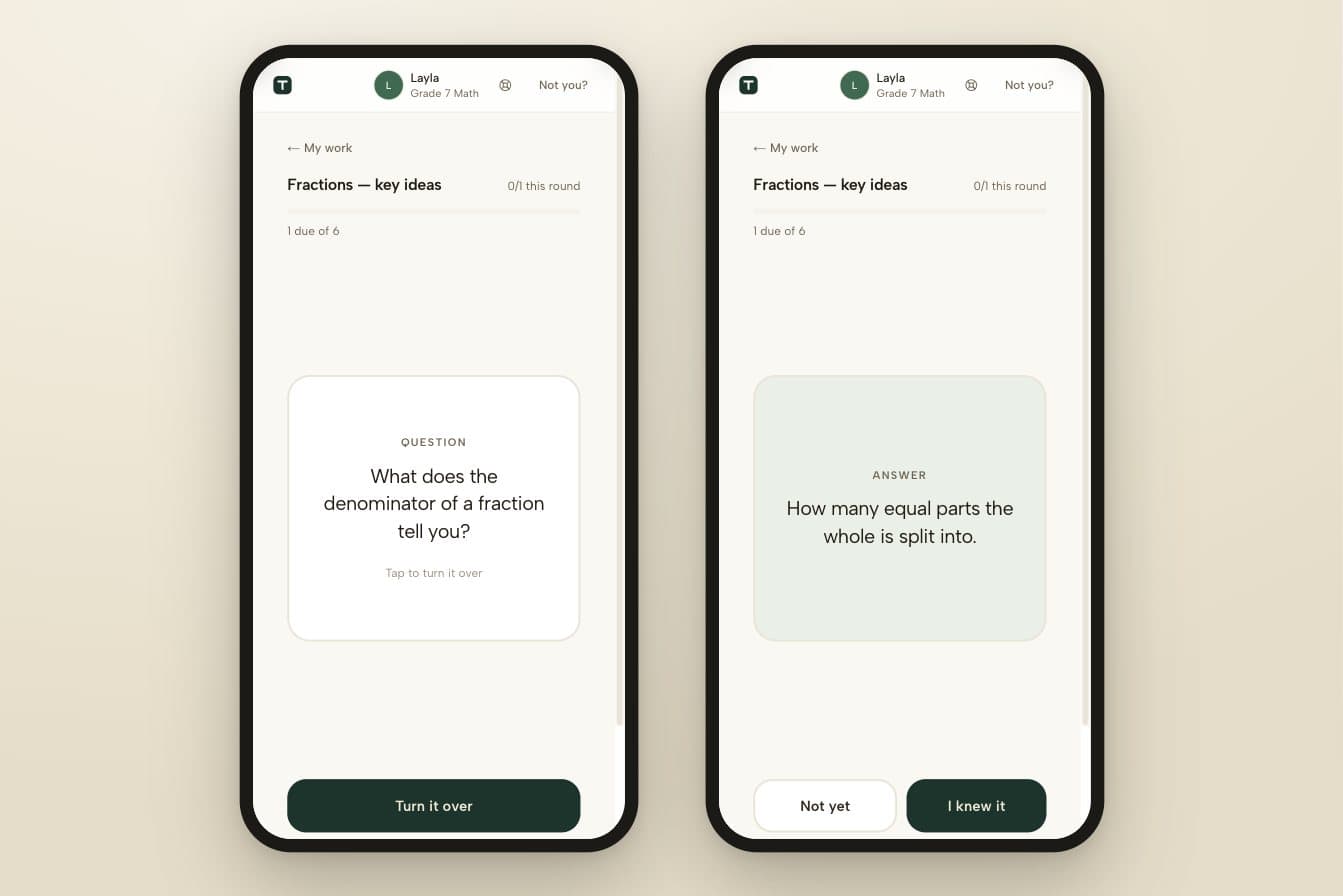
I build TeachRoster, so read this as a description. Its decks work like a Leitner box with the boxes hidden. A student sees the front, answers in their head, turns it over, and taps “Not yet” or “I knew it”. A card that is not known yet comes back in the same sitting. A card that is known comes back after 1 day, then 3, 7, 16 and 35, so the easy cards drift away and the hard ones keep coming back.
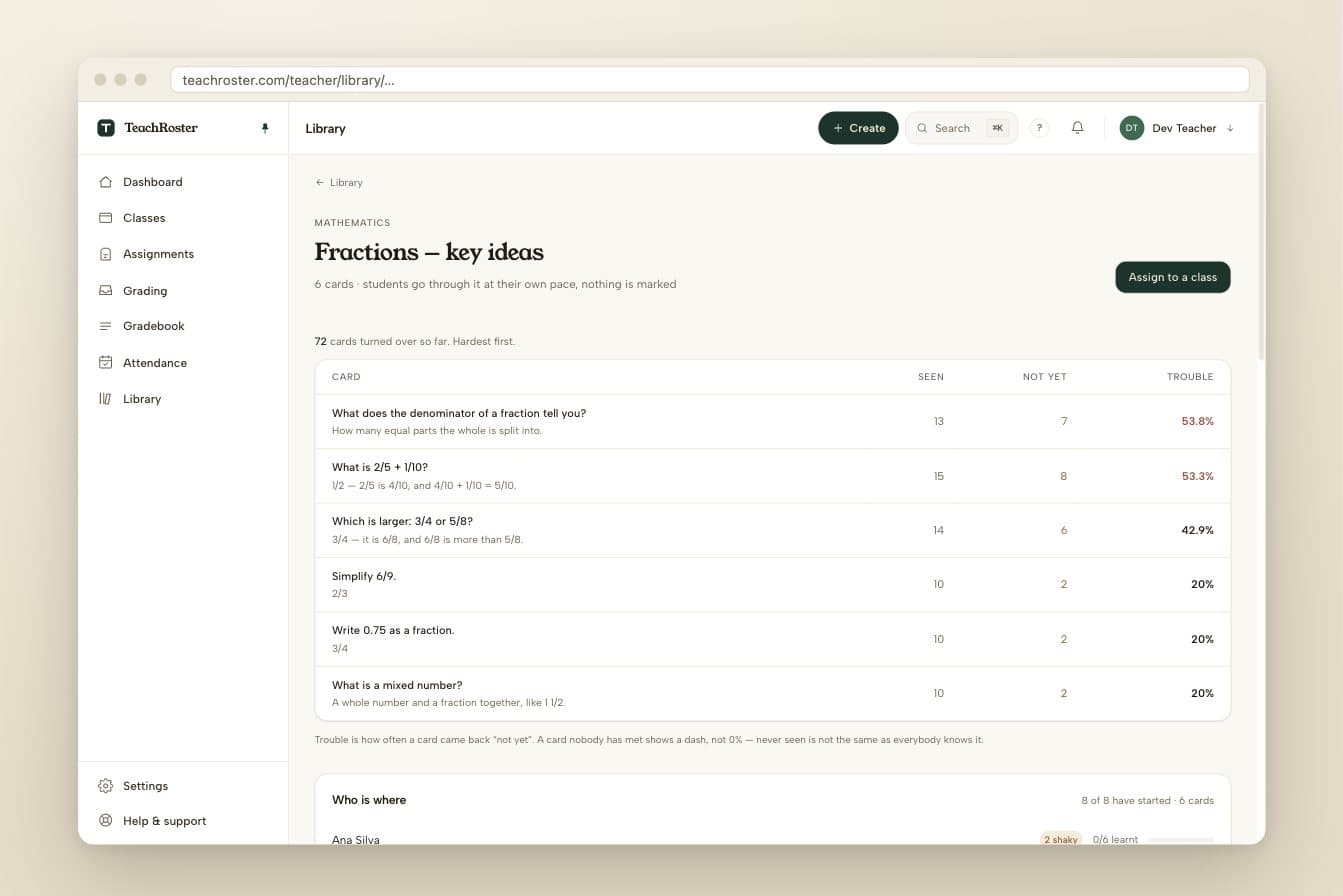
The teacher’s side is the part a paper deck cannot give you: which cards the class keeps getting wrong. In the example below, eight students have been through a fractions deck, and the hardest card is not the arithmetic — it is what a denominator means. That is a five-minute reteach for tomorrow’s starter, and a good card to open the next game of Quiz-Quiz-Trade with.
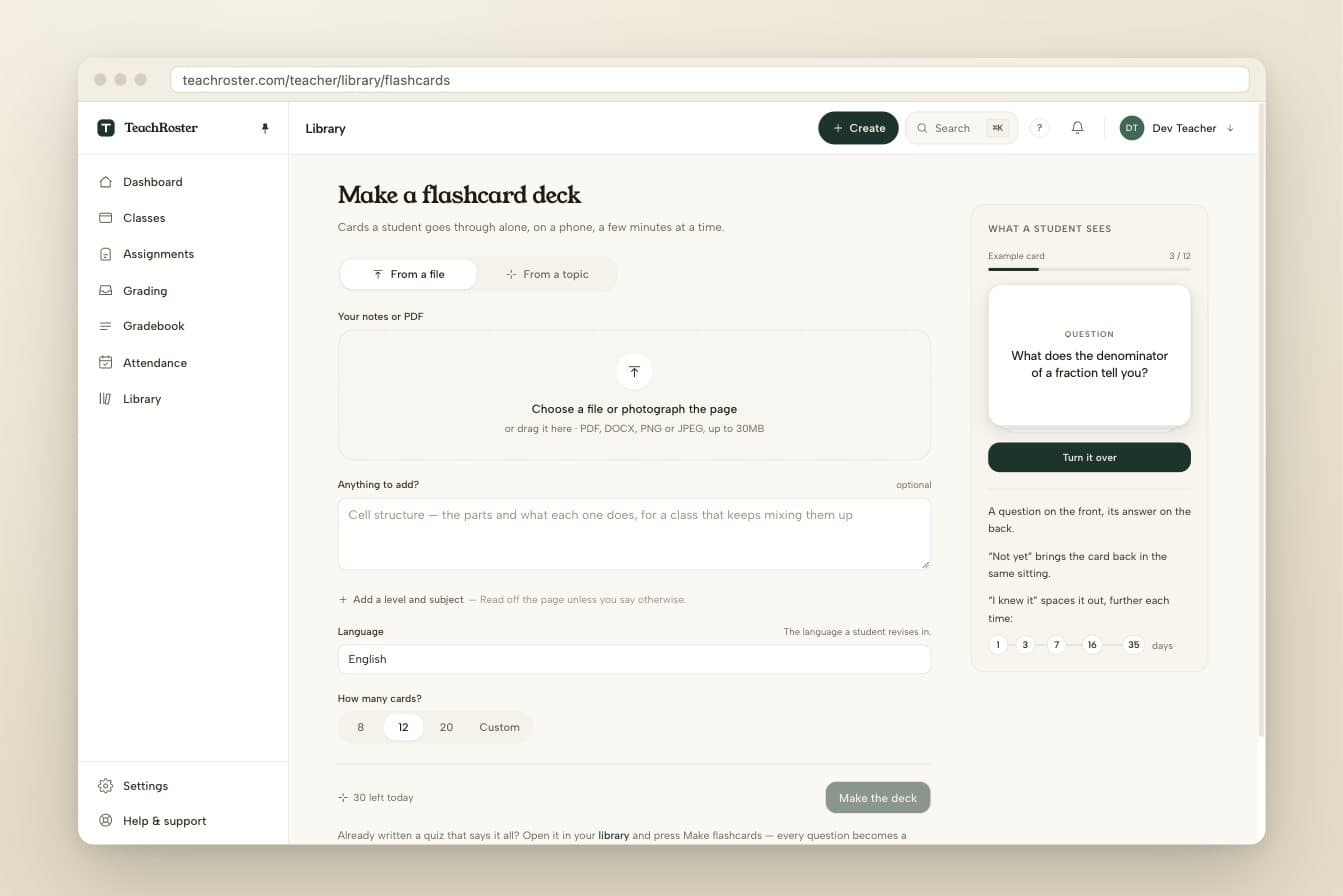
Decks can be made from the notes or PDF you taught from, from a topic, or from a quiz you have already written, and you read and edit every card before students see it.
None of the games need any of that. A pack of index cards and the two rules will take a class a long way; the app is for the days between.
Questions teachers ask
What are good flashcard games for high school?
Games where every student answers every card, not just the fastest one: Quiz-Quiz-Trade, three piles in pairs, a Leitner box, reverse cards and beat-your-own-score rounds all work with older students. Classic games like Around the World are fun but let a few students do all the remembering, so give everyone a mini whiteboard to answer on.
How do you use flashcards effectively?
Say or write the answer before turning the card over, keep going back to a card after you get it right instead of dropping it, and spread the practice over days rather than doing it all at once. Kornell (2009) found spaced flashcard study beat cramming for 90 percent of participants.
What is the Leitner system?
A way of spacing flashcards with a row of boxes, described by Sebastian Leitner in the 1970s. Every card starts in the first box. A card answered correctly moves one box along, where it is reviewed less often; a card that is missed goes back to the first box. The cards a student knows least are the ones they see most.
Are flashcards only good for memorising facts?
They are best for facts, terms and steps, which is where most students use them. They can push towards understanding when the card asks why or how, or when students sort cards into groups and explain the sort — but a flashcard is not a substitute for a worked example.
Sources
- Kornell, N. (2009). Optimising learning using flashcards: Spacing is more effective than cramming. Applied Cognitive Psychology, 23(9), 1297–1317.
- Kornell, N., & Bjork, R. A. (2008). Optimising self-regulated study: The benefits — and costs — of dropping flashcards. Memory, 16(2), 125–136.
- Wissman, K. T., Rawson, K. A., & Pyc, M. A. (2012). How and when do students use flashcards? Memory, 20(6), 568–579.
- Dunlosky, J., Rawson, K. A., Marsh, E. J., Nathan, M. J., & Willingham, D. T. (2013). Improving students’ learning with effective learning techniques. Psychological Science in the Public Interest, 14(1), 4–58.
- Kagan Publishing. Cooperative learning structures, including Quiz-Quiz-Trade.